🇬🇧 English spelling and grammar tricks for kids: the mnemonics that stick
It’s the third time this week. “Their” instead of “there”, “becuase” in the middle of a lovely story, “I seen it” in the homework diary. Your child knows the rules — they just can’t find them while the pencil is moving. Copying the word out ten times rarely helps: the next day, the mistake is back.
English spelling is famously unfair: the same sound can be written five different ways, and some letters make no sound at all. The good news is that almost every trap has a trick — a silly sentence, a picture, a word hidden inside another word. That’s exactly what a spelling mnemonic does: it gives the brain a hook.
Here are the ones that really work for children aged 6 to 11 — homophones, tricky words, irregular verbs and a few grammar traps — and how to use them without turning the kitchen into a classroom. You can try the first one tonight.
Why a trick beats writing the word ten times
Copying a word ten times trains the hand, not the memory: after the second line, your child copies the line above instead of recalling the word. A mnemonic works the other way round: it links the tricky part of the word to something your child already knows — an image, a rhyme, a story. The brain remembers what it can connect.
Second rule: test instead of rereading. Hide the word, ask your child to write it from memory, then check together. This recall step is what makes a spelling last until Friday’s test — and beyond. We explain the method in our article on how to learn a lesson by heart.
Homophones: their, there and they’re (and friends)
These words sound exactly the same, so the ear can’t help. The trick is to look inside each word: every one of them hides a clue.
- their → belongs to them. It hides heir, someone who inherits: their bikes.
- there → a place. It hides here: over there, near here.
- they’re → short for they are; the apostrophe replaces the missing a: they’re late.
The test that always works: say “they are” in the sentence. If it still makes sense, write they’re. If you can point at it, write there. Otherwise, it’s their. The same kind of test solves the other famous pairs:
- your or you’re? Say “you are”. “You are coat” makes no sense, so it’s your coat.
- its or it’s? Say “it is”: it’s raining, but the dog wagged its tail. Belonging never takes an apostrophe here, just like his, hers and ours.
- to, too or two? Two hides a w, like twins and twice; too has an extra o because it means “extra” (too hot, me too); to is for everything else.
- hear or here? You hear with your ear.
Spelling demons: one silly sentence per word
Every class has the same list of words that are misspelled again and again. For each of them there is a silly sentence — and it works precisely because it is silly.
| Word | The trick | What it fixes |
|---|---|---|
| because | Big Elephants Can Always Understand Small Elephants | the order of the letters |
| necessary | a shirt has one Collar and two Sleeves | one c, two s |
| separate | there’s a rat in separate | no more “seperate” |
| friend | a friend is there till the end | ie, not ei |
| piece | a piece of pie | ie, not ei |
| believe | never believe a lie | ie, not ei |
| rhythm | Rhythm Helps Your Two Hips Move | a word with no obvious vowel |
| island | an island is land with water all around | the silent s |
| Wednesday | say it in your head: Wed-nes-day | the silent d |
Never give more than two new sentences in one evening. After six, your child remembers the elephants, but not the word they were spelling.
Three rules that explain dozens of words
“i before e, except after c”
It’s the most famous spelling rhyme in English: i before e, except after c. It explains believe, field and chief on one side, receive and ceiling on the other. Give your child the honest version: the rule works best when the letters make an “ee” sound. When they sound like “ay”, it’s often ei (neighbour, eight, weigh), and a few rebels such as weird and seize simply have to be learned. For primary school, the short version is plenty.
The magic e
A silent e at the end of a word makes the vowel before it say its name: hat → hate, kit → kite, hop → hope, cub → cube. Children love the idea of a “bossy” letter that never speaks but makes another vowel shout. Play it as a game: write a short word, add an e, and read the new word together.
Double or not? The hopping rule
Short word, one vowel, one final consonant → double the consonant before -ing, -ed or -er: hop → hopping, run → running, big → bigger. Why? To keep the vowel short: hoping, with one p, comes from hope. The whole rule fits in one line: one vowel, one consonant: double up!
Irregular past tenses: learn them in sound families
“I goed”, “she runned”, “we buyed”: young children make these mistakes precisely because they have understood the rule — add -ed — and apply it everywhere. The fix is not a long alphabetical list but sound families: verbs that change in the same way, learned together like a song.
| Family | Pattern | Other verbs | The trick |
|---|---|---|---|
| i → a | sing → sang | ring, drink, swim, begin | Chant it: “sing, sang — ring, rang — drink, drank”. One tune for five verbs. |
| -ought | bring → brought | buy, think, fight | They all end with the same sound: say them in a row to hear the rhyme. |
| -ew | know → knew | grow, throw, blow, fly | The past ends in -ew: fly, flew; grow, grew. |
| The lazy ones | cut → cut | put, hit, let, shut | Nothing changes: just spot them. |
Two verbs belong to no family: be (was/were) and go (went). They’re loners — learn them on their own. And for the slip every teacher corrects, I seen it: the forms ending in -en and done always need a helper word. I saw it or I have seen it; I did it or I have done it.
Grammar traps with a built-in trick
- was or were? I, he, she, it → was; you, we, they → were. And you always takes were, even for one person.
- a or an? It’s about the sound, not the letter: an apple, an hour, but a banana, a unicorn. Say “a apple” out loud: the n is only there to help your mouth.
- The magic -s of he, she and it: in the present, one person or thing takes an -s: I play, he plays. Think of it as a little hiss for one single person.
- good or well? Good describes a thing (a good player), well describes an action (she plays well).
- No double negatives: “I don’t want nothing” actually means you want something. With not, use any: “I don’t want anything.”
Beyond spelling: the classic memory sentences
Once your child has discovered that a silly sentence can hold a whole list, they will want more. Three classics every family should know:
- Never Eat Shredded Wheat: the points of the compass, clockwise — North, East, South, West.
- Richard Of York Gave Battle In Vain: the colours of the rainbow — red, orange, yellow, green, blue, indigo, violet.
- My Very Easy Method Just Speeds Up Naming: the eight planets from the Sun, Mercury to Neptune — it’s one of the 175 memory tricks on our dedicated page.
The cards-on-the-door ritual: five minutes a day
A mnemonic doesn’t replace practice: it makes it short. The rhythm that lasts all year fits one rule: three to five tricky words a week, a few minutes a day. Not an hour on Sunday night.
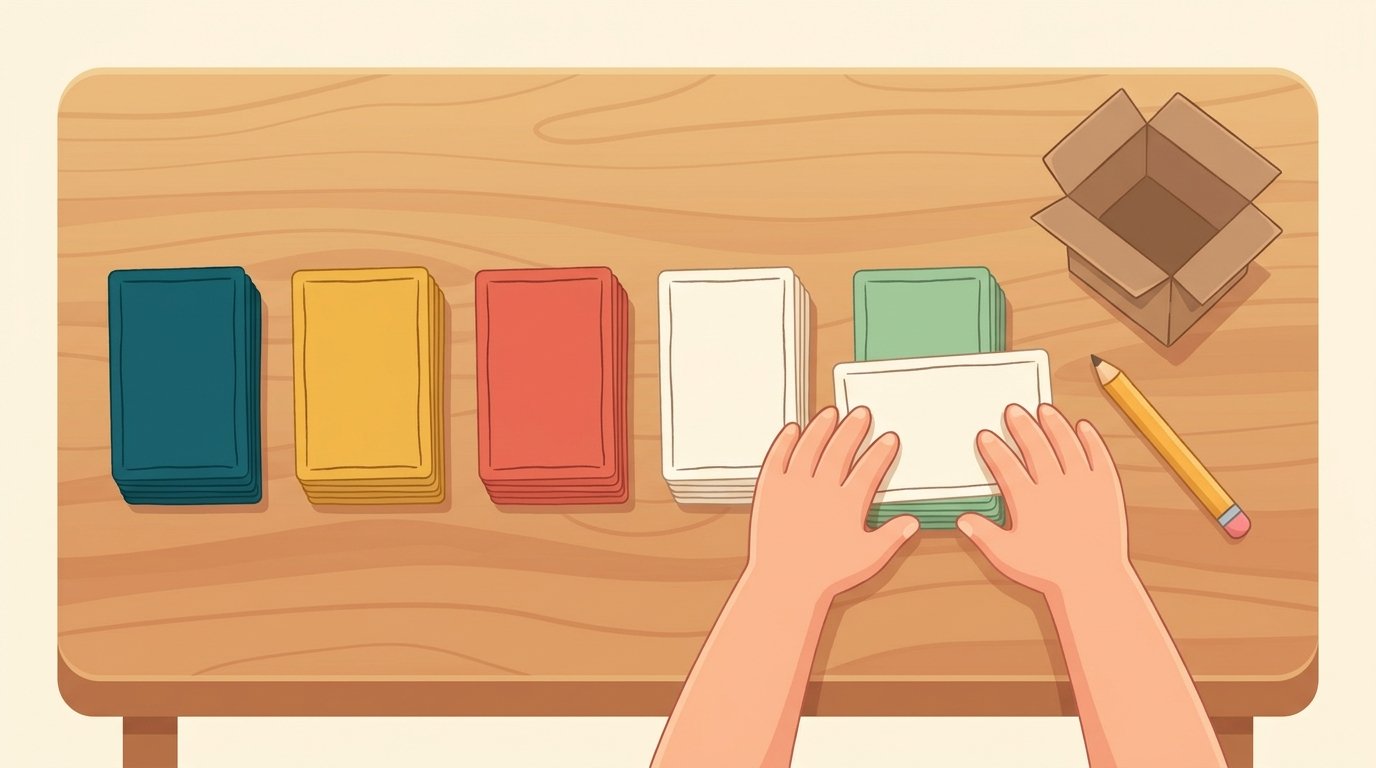
- Monday: choose. Pick three to five words from the spelling list or from your child’s own mistakes. Write each one on a card, with the trick on the back.
- Tuesday: say it. Read each trick aloud together — the sillier the voice, the better.
- Wednesday: write from memory. Card turned over, your child writes the word, then checks.
- Thursday: use it. One sentence per word, even a wobbly one: “My friend ate a piece of pie.”
- Friday: mix it up. This week’s words, plus two old ones picked at random. That mix is what stops last month’s words from slipping away.
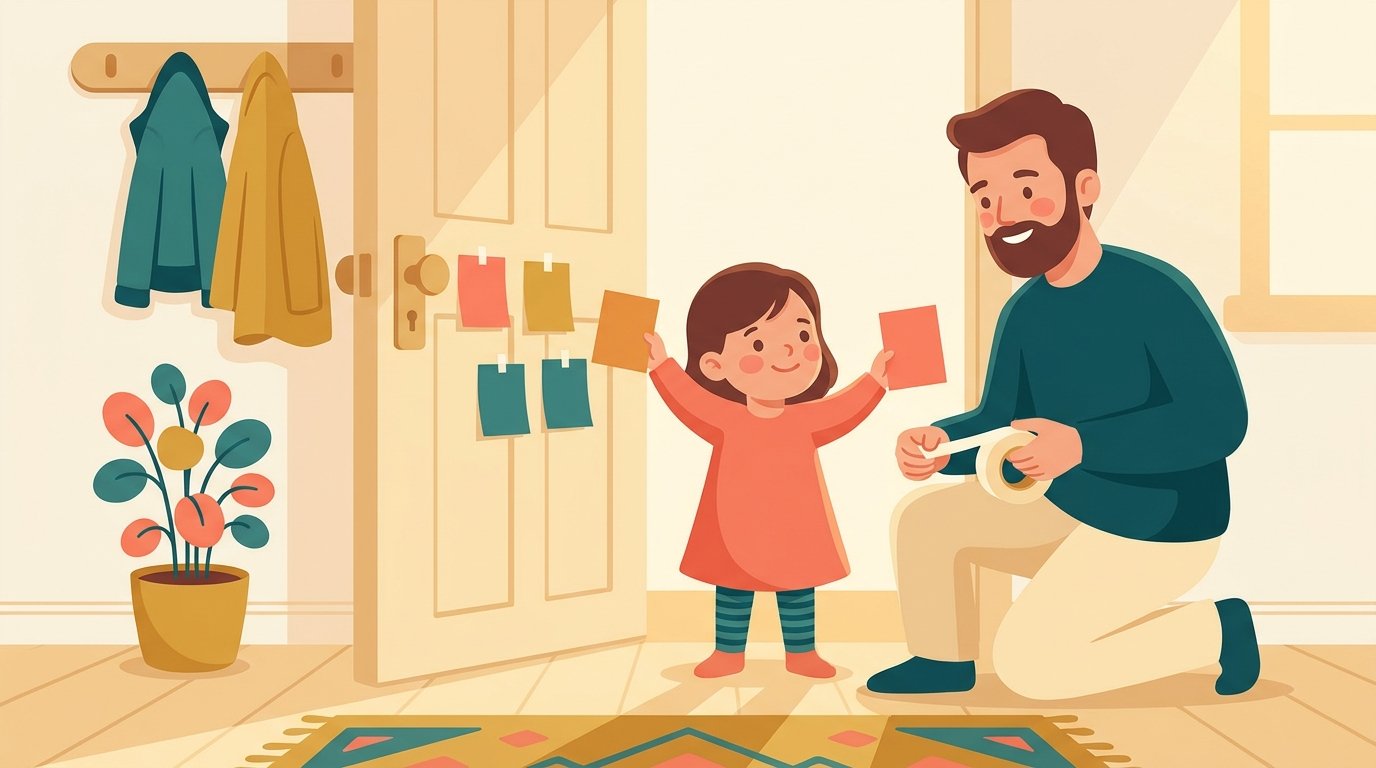
Stick the week’s cards inside a door you open every day: your child will see them dozens of times without “revising”.
Three mistakes that waste time
- Wanting a trick for everything. A trick is for a specific trap. Most words follow the rules and need no magic sentence.
- Giving all the tricks the night before the test. A trick discovered at 8 pm is forgotten with the rest. It needs to be in place before it’s needed.
- Correcting every mistake at once. Pick the one or two that come back most often; the others can wait. Six new tricks in one week turn into a jumble.
Looking for more? Our page of memory tricks from age 6 to 11 covers maths, science and history with the same approach. And if you’d like all these tricks in one place, The Big Book of Memory Tricks brings together 175 illustrated tricks for ages 6 to 11 — including a whole chapter on English spelling, from their/there/they’re to the magic e.
Above all, remember: one trick per trap, two new ones per evening at most, and a little every day. Spelling becomes a game again — and “becuase” quietly disappears from the homework diary.
📘 All these tips are also in book form: The Big Book of Memory Tricks — 175 tricks from CP to CM2, in 9 subjects.
Want to put these tips into practice?
Every day, a new adventure workbook adapted to your child's school level — to print or do on screen. No commitment.
Your questions
What’s the best trick to help a child with English spelling?
Look for what the word hides: their hides heir (belonging), there hides here (a place), and a friend is there till the end. For words with no logic, use a silly sentence, such as Big Elephants Can Always Understand Small Elephants for because. Then test instead of rereading: hide the word, write it from memory, check.
How do you remember their, there and they’re?
Say “they are” in the sentence: if it still works, write they’re. If you can point at it, it’s there, which hides the word here. Otherwise it’s their, which hides heir, someone who owns something.
Is “i before e except after c” really true?
Mostly, when the letters make an “ee” sound: believe, field, receive, ceiling. When they sound like “ay”, it’s often ei (neighbour, eight, weigh), and a few words such as weird and seize break the rule. For primary school, the short version is enough.
From what age can children use spelling mnemonics?
From about 6 or 7, as soon as they write whole words: the magic e and hear/here work very early. Silly sentences for long words such as because or necessary suit children from 8 or 9. Keep it to one or two new tricks at a time.
How many spelling words should we practise each week?
Three to five tricky words a week is plenty: a few minutes a day, one card per word with the trick on the back, and a Friday mix with older words. Regularity matters far more than the time spent.
My child is mixing up two tricks—what should I do?
It’s usually a sign of too many at once. Keep the one they like best, ideally one they invented, and wait a week before adding another. Two solid tricks are better than six shaky ones.
Next to read
 Memory Tricks & Recall
A or à: the “avait” trick so you never get it wrong again
A or à: learn the 'avait' trick, see clear examples, avoid common mistakes (il y a, capital À), and try a practice exerc…
 Memory Tricks & Recall
How to memorise a lesson (and remember it for the test)
A 5-step method to memorise a lesson, from CP to CM2: understand, break it down, recite with your notebook closed, get s…
 Memory Tricks & Recall
7️⃣ The 7 Times Table: just one really new result, plus all the tips
The complete 7 times table, what your child already knows from other tables, tricks for 7 × 7 and 7 × 8, fun games and a…
 Memory Tricks & Recall
Visual or Auditory Memory in Children: What Really Works
Visual or auditory memory in children: what research actually says, why labels can be unhelpful, and how to revise a les…
 Memory Tricks & Recall
Et or est: the 'était' trick to never get it wrong again
Et ou est: the 'était' and 'et puis' tip explained for your child, checked examples, common traps (c'est, l'est) and a c…
 Memory Tricks & Recall
How to remember history dates: timelines, stories and mental images
How to remember history dates without mindless repetition: mental images, stories, the hallway timeline and 12 key dates…