✍️ English verbs for kids: 7 tricks for tenses that really work
In the evening, he recites his irregular verbs without a single mistake. The next day, his story comes back with “we was”, “I seen it” and “she runned”. Every parent knows this scene, and it has nothing to do with how hard the child is working.
The good news: to master English verbs, children don’t need endless tables. English verbs are far more regular than they look, and a handful of well-chosen tricks cover most of the verbs your child will write before secondary school. We have gathered them, along with other classic traps, in The Big Book of Memory Tricks. Here they are, with quick tests you can do at the table.
Why verbs are tricky, even when the lesson is known
Three reasons — and none of them is called “not working hard enough”.
1. Everyday speech is forgiving. Many children hear “we was” or “I done it” around them, and the ear gets used to it. Writing asks for the standard form, which isn’t always the one they hear.
2. We learn verb by verb. Reciting go-went-gone, then see-saw-seen, then take-took-taken is just stacking lists, never seeing what they have in common. And irregular verbs have a lot in common.
3. The rule isn’t at hand mid-sentence. In the middle of a story, a child doesn’t have time to consult a table: they write by ear. The tricks below don’t replace the lesson — they give a two-second check that works mid-sentence.
Trick 1: find the subject before the verb
This is the most useful habit of all. In the present tense, the verb changes with who is doing the action. So before asking “how do I spell this verb?”, your child asks “who is doing it?”. The table fits on a card the size of your hand:
| Subject | Present | Past of “be” | Watch out |
|---|---|---|---|
| I | I play · I am · I have | I was | “I” always takes a capital letter |
| you | you play · you are · you have | you were | “you” takes were, even for one person |
| he / she / it | he plays · she is · it has | she was | the only line with an -s on the verb |
| we | we play · we are · we have | we were | never “we was” |
| they | they play · they are · they have | they were | never “they was” |
Look at the he/she/it line: it explains one of the most common mistakes in primary school, “she play”. That little -s is easy to forget — unless your child gets into the habit of checking the subject first.
Trick 2: the magic -s of he, she and it
In the present tense, when the subject is he, she or it — one person or one thing — the verb takes an -s: I play, he plays; they run, the dog runs. Think of it as a little hiss for one single person: “she playsss”. Two or more? No hiss.
- After s, x, ch, sh, add -es: watch → watches, fix → fixes, wash → washes.
- Consonant + y → -ies: fly → flies, carry → carries. But vowel + y just adds -s: play → plays.
- Three rebels to know by heart: have → has, do → does, go → goes.
One boss, one -s: in the present, the -s goes either on the noun (the dogs run) or on the verb (the dog runs), never on both.
Trick 3: the regular past and its three spelling rules
For most verbs, the past is easy: add -ed. It can sound like “t”, “d” or “id”, but it is always spelled the same way: jumped, played, wanted. That one rule fixes a lot of “jumpt” and “playd”.
- Verb ending in e → just add d: like → liked, smile → smiled.
- Consonant + y → -ied: cry → cried, carry → carried (but play → played).
- Short verb, one vowel + one consonant → double it: stop → stopped, clap → clapped, hop → hopped.
The same rules work for -ing: make → making (the e goes), run → running (the n doubles), hop → hopping. Compare with hope → hoping: one p, because the magic e was there.
Trick 4: irregular verbs in sound families
Some verbs refuse -ed. Instead of learning them in alphabetical order, learn them in families that sound alike, like a song:
- -ew family: blow → blew, grow → grew, know → knew, throw → threw, fly → flew.
- -ought family: buy → bought, bring → brought, think → thought, fight → fought (and its cousins with -aught: catch → caught, teach → taught).
- i – a – u family: sing → sang → sung, ring → rang → rung, drink → drank → drunk, swim → swam → swum, begin → began → begun.
- no-change family: cut → cut, put → put, hit → hit, let → let, shut → shut.
- the true rebels, to learn by heart: be → was/were, go → went, eat → ate, see → saw, do → did.
Say each family out loud three times, clapping on each form. The ear learns the rhythm before the head learns the list.
Trick 5: “did” or “done”, “saw” or “seen”: the helper test
Some verbs have two past forms, and children love to swap them. The rule: the second form (done, seen, gone, eaten, written) always needs a helper — have, has or had.
- “I did it” ✓ · “I have done it” ✓ · “I done it” ✗
- “I saw him” ✓ · “I have seen him” ✓ · “I seen him” ✗
- “She went home” ✓ · “She has gone home” ✓ · “She gone home” ✗
The test fits in one question: “Is there a have just before?” No helper → did, saw, went. A helper → done, seen, gone.
Trick 6: talking about the future
The future is the easiest tense in English: will + the verb, unchanged. I will play, she will play, they will play — no -s, no -ed, for every person. The same goes after can, must and should: “she can run”, never “she can runs”.
The other everyday future is going to: “I’m going to read”. The only trap is the part of “be” in front: I am going to, she is going to, they are going to.
Trick 7: the verb of the day, five minutes at the table
Verbs don’t need long sessions, just short, regular bursts. The routine that lasts all year fits into dinner time:
- Pick a verb at random (labels in a jar, or the first verb you hear on the radio).
- Pick a time: yesterday, today or tomorrow.
- Go round the table out loud, one person each: I, you, he, we, they. Parents join in too, and are allowed to make mistakes.
- On Fridays, write it down: just two sentences, using the week’s trickiest verb.
A few minutes every day beat a long session with tables on Sunday evening. It’s the same idea as for tricky words: short, repeated practice, with a spaced reminder a few days later.
Verbs from age 6 to 11: what to aim for
Progress varies from school to school, but the pattern is the same: first the present of everyday verbs, then the past, then the finer points.
- Age 6-7: spotting the verb, the present with I/you/he/we/they, the -s of he/she/it, the -ed past of regular verbs.
- Age 7-8: was or were, the most common irregular pasts (went, saw, ate, came, took), the future with will.
- Age 8-9: the -ed and -ing spelling rules (stopped, making), irregular verb families, did/done and saw/seen with a helper.
- Age 9-11: the present perfect (I have eaten), the past continuous (I was reading), keeping the same tense all through a story, and more irregular verbs.
If your child is struggling, go back a step without guilt: everything builds on the level before. A ten-year-old who writes “we was” needs to revisit was and were, not the present perfect.
Want all these tricks in one place, handy at homework time? The Big Book of Memory Tricks brings together the verb tricks from this article, plus many more for spelling and maths, in short sentences to reread. And for the spelling side — their, there, they’re — our article on homophones is the perfect companion.
To try these tricks with real exercises, start with our free printable workbook: just a few pages, no sign-up needed. And if the routine sticks, the 31-Day Adventure is a free daily challenge to keep up the pace.
📘 All these tips are also available as a book: The Big Book of Memory Tricks — conjugation, spelling and more, with a tip for every tricky point.
Want to put these tips into practice?
Every day, a new adventure workbook adapted to your child's school level — to print or do on screen. No commitment.
Your questions
How can I help a child who mixes everything up with verbs?
Start with one habit: find the subject before writing the verb, then check the form (he, she, it → an -s in the present; you, we, they → were). Work on one tense at a time, starting with the present. A few minutes of speaking practice each day, with a “verb of the day” routine, beats a long weekend session.
Should children learn lists of irregular verbs by heart?
Reciting a list in order can be reassuring, but it isn’t enough: the child then has to run through the whole list to find one form. Learn the verbs in sound families (blew, grew, knew…), then move on to random questions: “catch, yesterday?”, “swim, I have…?”. That quick recall is what writing needs.
What’s the trick for was or were?
I, he, she and it take was; you, we and they take were. “You” always takes were, even when you are talking to one person: “you were late”. So “we was” and “they was” are always mistakes in writing.
What’s the difference between did and done?
Did stands on its own: “I did my homework”. Done always needs a helper in front of it — have, has or had: “I have done my homework”. The same test works for saw/seen, went/gone and ate/eaten.
My child gets verb exercises right but makes mistakes in their writing. Why?
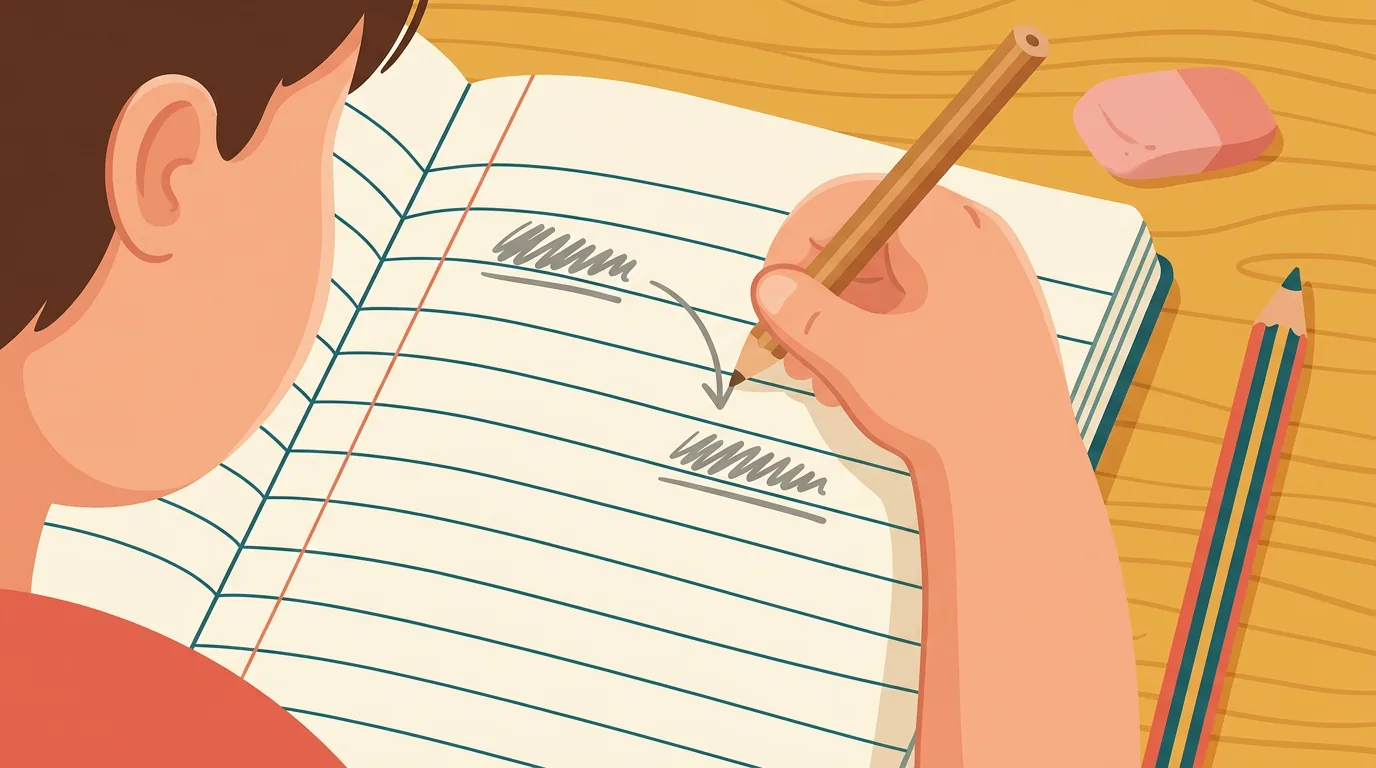
Because exercises give them the tense and the subject in advance: all they have to do is apply the rule. In writing, they have to spot all that themselves while coming up with ideas. The solution is a special read-through just for verbs: underline the subject, draw an arrow to the verb, check the form.
How can I help if I’m not sure of the rules myself?
You don’t need to be an expert: the tests in this article work without any grammar knowledge. Who is doing it? Is there a helper? Is it yesterday, today or tomorrow? You can ask your child these questions even if you don’t know the answer — and it’s actually more effective, because it gets them thinking.
Read next
 Memory Tricks & Recall
Homophones: tricks to stop mixing up their/there/they’re, your/you’re and its/it’s
Homophones made easy: their, there or they’re? your or you’re? its or it’s? The swap test that works every time, a table…
 Memory Tricks & Recall
Tricky words: the list from age 5 to 11 and 6 ways to remember them
Tricky words (the ones you can’t sound out): the list by age from 5 to 11, the traps to highlight and 6 simple ways to r…
 Memory Tricks & Recall
How to remember history dates: timelines, stories and mental images
How to remember history dates without mindless repetition: mental images, stories, the hallway timeline and 12 key dates…
 Learning through play
Halloween activities for children: 12 clever ideas to try at home
Halloween activities for kids: 12 simple ideas to do at home (crafts, cooking, games, stories), organised by age, with a…
 Memory Tricks & Recall
Visual or Auditory Memory in Children: What Really Works
Visual or auditory memory in children: what research actually says, why labels can be unhelpful, and how to revise a les…
 Learning through play
Educational board games for ages 6-10: our skill-based picks
Educational board games for ages 6-10: our selection by skill (mental maths, words, logic, memory) and how to turn any g…